How to Use Upfront Deposits Without Scaring Clients Off
Upfront deposits help you organize your schedule better

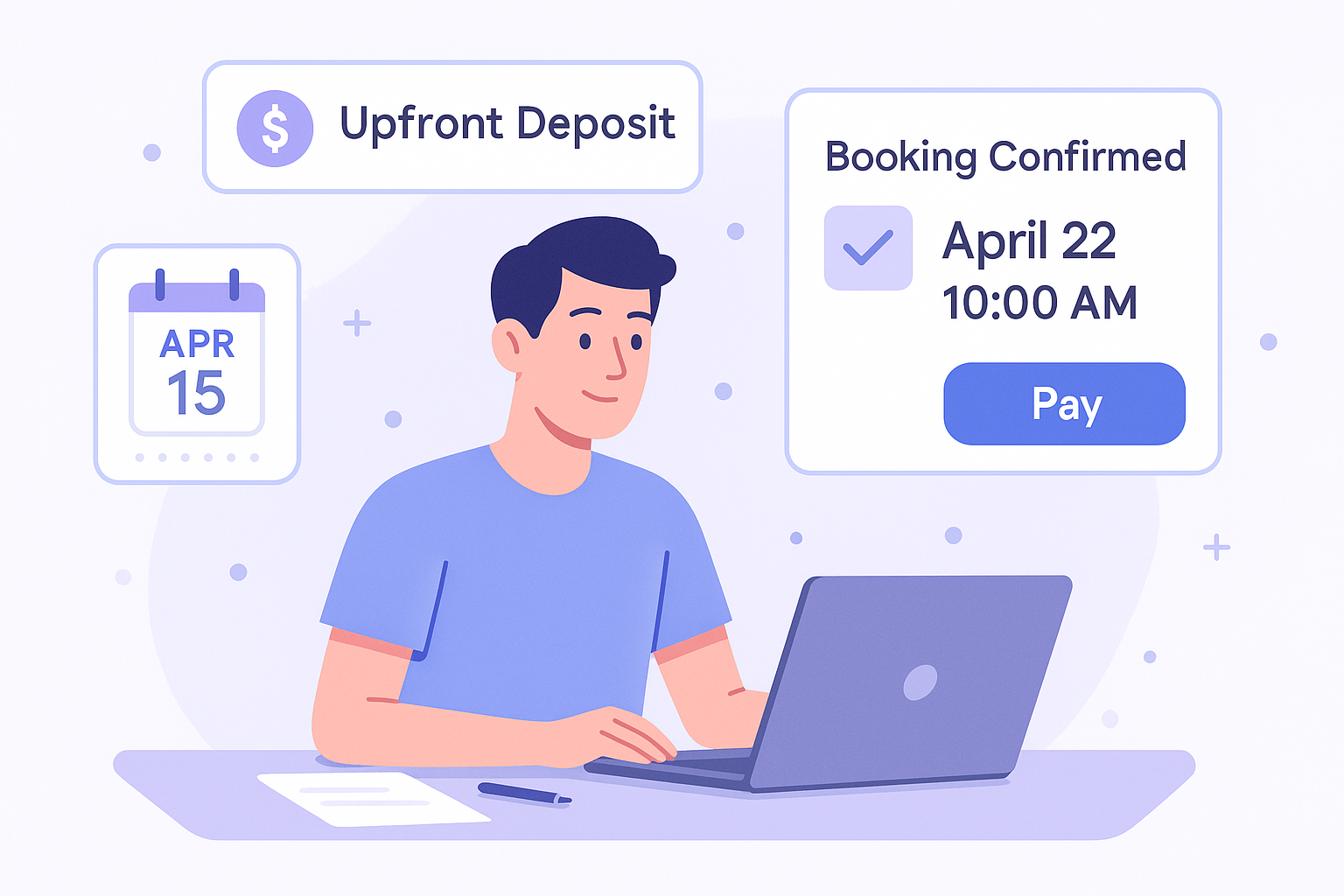


If you run a service-based business or freelance, you’ve almost certainly met The Vanisher:
- They excitedly book a session.
- You block off time, maybe even prepare work.
- The day comes… and they disappear. No reply. No apology. No payment.
It feels terrible and it costs you money.
That’s why more and more freelancers, coaches, agencies, and small businesses are introducing upfront deposits. Done right, deposits protect your time, filter out flaky clients, and stabilise your cash flow.
Done wrong, they can feel aggressive, confusing, or unprofessional—and yes, they might scare good clients away.
This guide walks through exactly how to use upfront deposits without scaring clients off, including:
- When you should charge a deposit (and how much)
- How to explain deposits so clients feel safer, not suspicious
- Practical policies that reduce ghosting and drama
- Tools that make deposit-based booking feel smooth and modern
Let’s turn “I hope they show up” into “This time is paid and confirmed.”
Why Upfront Deposits Actually Help Serious Clients
A lot of business owners worry: “If I ask for a deposit, will people think I’m greedy or desperate?”
In reality, serious clients appreciate clear structure. Deposits signal:
- You take your work seriously
- Your time is valuable
- This is a professional engagement, not a favour
Think about the services you personally trust:
- Hotels
- Dentists
- Hair salons
- Lawyers
- High-demand consultants
Many of them use some form of prepayment, deposit, or cancellation fee. It’s a normal part of doing business.
Your job isn’t to avoid deposits. Your job is to explain them clearly and fairly.
When You Should Use Upfront Deposits
You don’t need a deposit for every interaction in your business. But they make a huge difference when:
1. Your time slots are limited
If you can only work with a small number of clients per week (e.g. coaching, consulting, 1:1 services), a no-show doesn’t just hurt your ego—it’s lost income. A deposit ensures that:
- The slot is reserved for someone committed
- Last-minute cancellations at least partially compensate you
2. There is preparation or material cost
If you:
- Prepare customised plans
- Purchase materials
- Reserve third-party resources
…then not charging something upfront is pure risk.
3. Your niche has high no-show risk
Industries like:
- Beauty and wellness
- Personal training
- Coaching/therapy
- Small local services (repairs, home visits)
…often suffer from casual bookings that never show up. Deposits act as a polite filter.
4. You’ve been burned before and it’s affecting your mindset
If repeated no-shows are making you:
- Avoid booking new people
- Overthink every new inquiry
- Feel resentful with existing clients
…a deposit policy isn’t just about money. It’s about your mental bandwidth and ability to serve good clients well.
How Much Should You Charge as a Deposit?
There’s no universal magic number, but there are good guidelines.
Option 1: Flat fee
- Good for simple services
- Easy to communicate
- Example: $20 deposit for all appointments
Option 2: Percentage of the total
- Feels fair for larger projects
- Scales automatically with price
- Common percentages: 20–50%
For small one-off bookings (like a hair appointment or single coaching session), 20–30% or a modest flat fee usually feels appropriate.
For larger projects (websites, branding, consulting packages), 30–50% upfront is completely standard and widely accepted.
Whatever you choose, make sure it:
- Covers your preparation time and basic risk
- Still feels reasonable for your target client
You don’t need to squeeze every drop of protection from your deposit. You just need to make not-showing-up too expensive to be casual about.
The Real Secret: It’s All About How You Frame the Deposit
Clients rarely reject the existence of a deposit; they react to how it’s communicated. Here’s how to make your deposits feel normal and reassuring.
1. Lead with value, not with rules
Bad framing: “I require a 40% deposit, otherwise I won’t work with you.”
Better framing: “To lock in your date and start preparing your project, there’s a 40% deposit. This ensures your spot is reserved in my schedule and allows me to get started immediately.”
You’re not just charging to charge; your deposit does something for them—it secures your time and attention.
2. Put deposits in your public pricing & FAQs
If clients only learn about your deposit at the very last moment, it feels like a surprise fee. Instead:
- Mention it clearly on your website, service pages, and booking flows
- Use simple language: “A 30% deposit is required to confirm your booking.” or “Bookings are confirmed once the deposit is paid online.”
Transparency builds trust.
3. Explain your cancellation / reschedule policy upfront
Clients fear deposits when they imagine worst-case scenarios: “What if I get sick?” or “What if something urgent happens?”
You can address that by showing you’re reasonable:
- Allow rescheduling within a certain window (e.g. 24–48 hours)
- Offer partial or full credit if they give enough notice
- Explain what happens in edge cases
Example policy: “Deposits are non-refundable for no-shows, but if you need to reschedule and give at least 24 hours’ notice, your deposit will be transferred to the new date.”
You’re not rigid. You’re just protecting your business from disrespectful behaviour.
4. Use professional language, not emotional language
Avoid:
- “I’ve had too many people waste my time…”
- “Because some clients don’t respect my work…”
Instead:
- “This policy exists to ensure fairness and protect reserved time for all clients.”
- “Deposits help keep the schedule reliable and reduce last-minute cancellations.”
Same meaning, very different feeling.
Practical Deposit Policies That Work and Don’t Feel Harsh
Here are some battle-tested structures you can adapt.
Policy A: Straight Non-Refundable Deposit
Best for:
- High no-show environments
- Lower-priced, high-volume services
Structure:
- 20–30% deposit payable at booking
- Non-refundable
- Can be transferred once if rescheduled before X hours
Policy B: Refundable Within Notice Period
Best for:
- Higher-priced services where relationship matters a lot
- Therapeutic, coaching, or consulting settings
Structure:
- 30–50% deposit
- Fully refundable if cancelled before X hours
- Non-refundable for no-show / last-minute cancellation
Policy C: Deposit as a Credit
Best for:
- Packages, retainers, or programs
Structure:
- Client pays a deposit that turns into credit on their first invoice
- If they vanish, you keep the deposit
- If they proceed, it simply counts toward the total
This is psychologically easier to accept because the deposit doesn’t feel like a “loss”—it feels like prepaying part of the work.
How to Introduce Deposits to Existing Clients Without Awkwardness
Introducing deposits to new clients is easy. Changing terms with existing clients is trickier, but still doable if you handle it with care.
Step 1: Explain the reason without blaming them
Send a short, honest message: “To keep my schedule fair and sustainable, I’m updating my booking policy. From [DATE], new appointments will require a small deposit to confirm the time slot. This helps reduce no-shows and makes sure I can stay fully available for committed clients.”
Step 2: Give them a transition period
You can soften the change by:
- Applying the new policy only to new clients, or
- Giving existing clients a grace period of one or two months
Example: “For current clients, I’ll continue with the old system until [DATE]. After that, deposits will apply to keep everything consistent.”
Step 3: Make paying the deposit absurdly easy
The faster and smoother deposit payment is, the less people think about it. That means:
- No manual bank transfers with screenshots
- No PDFs with instructions
- No “I’ll send an invoice later”
Just: Service selected → Time chosen → Deposit paid online → Booking confirmed.
That’s where a tool like Schemon changes the game, but we’ll come back to that.
Scripts You Can Steal for Talking About Deposits
Here are some ready-to-use lines for different channels.
Website copy
“A 30% deposit is required to confirm your booking. This secures your time in the calendar and allows us to prepare for your session.”
Email or DM
“To confirm your appointment on [DATE/TIME], a small deposit of [AMOUNT] is required. You can pay it securely using this link: [LINK]. Once it’s paid, you’ll receive an instant confirmation and reminders.”
When someone asks “Why do you charge a deposit?”
“I reserve specific time and prepare in advance for each client. The deposit simply protects that time and keeps the schedule fair for everyone. It’s applied toward your total and isn’t an extra fee.” Simple, calm, and professional.
Tools That Make Deposits Feel Effortless Instead of Awkward
The best deposit policy in the world will still feel clunky if the workflow is clunky.
To make deposits feel like a natural part of your client experience, you want tools that:
- Show your services, prices, and deposit rules in one place
- Let clients book a time and pay the deposit in the same flow
- Automatically add the booking to your calendar
- Send confirmation and reminder emails or messages
- Keep records of who paid what, and when
This is exactly where traditional “forms + manual invoice” systems fall apart. A specialised booking + payments tool keeps everything together:
- Fewer steps → Fewer drop-offs
- Less manual admin → More real work
- Cleaner, more professional vibe → More trust
How Schemon Helps You Use Deposits Without Scaring Clients Away
If you’re nodding along and thinking: “Yes, I want deposits—but I don’t want to build all this myself.”
…you don’t have to.
Schemon is built for freelancers and service-based businesses who want to:
- Showcase their services online
- Let clients book and pay without endless messages
- Use deposits in a way that feels smooth and professional
With Schemon, you can:
- Create bookable services with clear pricing and deposit rules
- Let clients choose a time directly from your real availability
- Collect deposits (or full payments) securely at the time of booking
- Sync everything with your calendar
- Automatically send confirmations and reminders
- Keep all client data and bookings in one dashboard
Instead of: “Can you do Tuesday? Okay, how about Wednesday? I’ll send you my bank details…”
Your process becomes: “Here’s the link to book. Choose a time and pay the deposit, and you’ll get an instant confirmation.”
No drama. No confusion. Just a clean, modern experience that actually increases trust.
Ready to Protect Your Time and Keep Clients Happy?
Upfront deposits don’t have to be scary—for you or for your clients. When you:
- Explain them clearly
- Apply them fairly
- Make paying them easy
…deposits become a simple part of doing business, just like booking a hotel or a flight.
You deserve to work with committed clients who respect your time.
Your clients deserve a booking experience that’s simple and clear.
👉 Set up your deposit-based booking system today with Schemon.
Create your services, define your deposit rules, share your booking link—and start enjoying a calendar full of confirmed, committed clients, not maybes.


Subscribe to our email newsletter today!