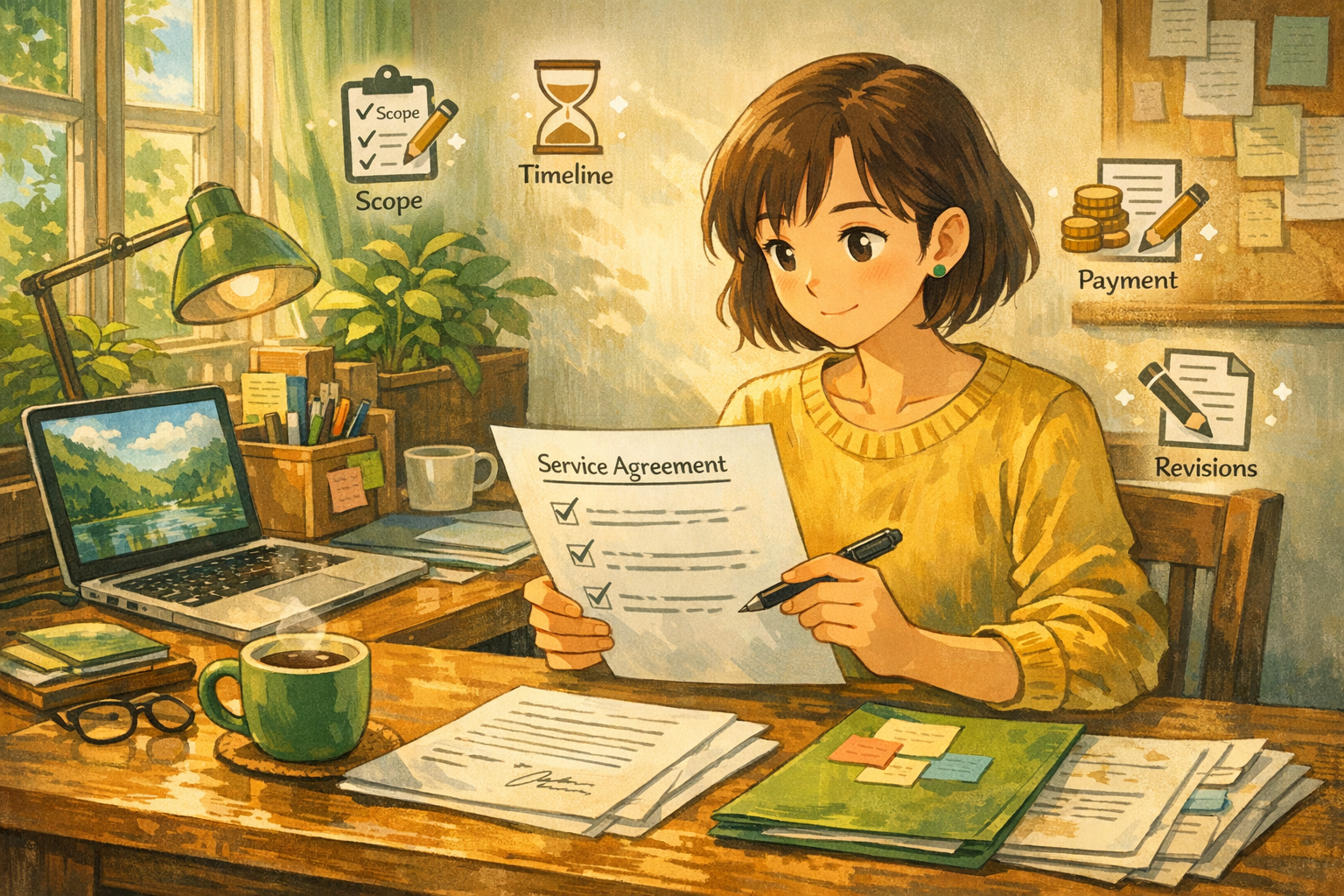
Legal Basics for Freelancers: Intellectual Property 101
Learn the IP basics every freelancer needs—copyright, trademarks, licensing, work-for-hire, and contract clauses—to protect your work and get


Freelancing is weirdly magical: you make ideas real, you ship value, you get paid (ideally), and then… the awkward part appears: Who actually owns what you just created?
That question is intellectual property (IP) in disguise. And IP disputes don’t usually start with villain laughter. They start with innocent sentences like:
- “Can we reuse this design for other projects?”
- “We assumed the code is ours since we paid.”
- “Can you remove it from your portfolio?”
- “We want to trademark the brand name you came up with.”
So here’s the freelancer-friendly breakdown of IP—what it is, what the common traps are, and how to set expectations clearly before you’re knee-deep in a project and someone discovers legal language exists.
Note: This is general educational info, not legal advice. IP rules vary by country, and the details matter. For high-stakes projects, a local lawyer is the cheat code.
What is intellectual property?
Intellectual property is a bundle of legal rights that protect creations of the mind—things like inventions, designs, writing, software, branding, and confidential business know-how. For freelancers, IP shows up in four big forms:
- Copyright – protects original creative works (writing, design, photos, video, software code, etc.).
- Trademarks – protect brand identifiers (names, logos, slogans) that signal source.
- Patents – protect inventions (new, useful technical solutions).
- Trade secrets – protect valuable confidential information (processes, formulas, customer lists, internal methods).
Most freelancers live primarily in copyright + contract land, with occasional visits to trademark and trade secrets.
Copyright: the default “ownership engine” for freelance work
When does copyright start?
In many jurisdictions, copyright protection begins automatically when an original work is created and “fixed” in a tangible form (written down, saved, recorded, etc.).
Translation: if you design a logo, write copy, compose a melody, shoot photos, or write code—copyright likely exists without you filing paperwork.
What copyright actually controls
Copyright usually covers:
- copying/reproducing the work
- distributing it
- displaying it publicly
- making “derivative works” (adaptations, edits, new versions)
The big freelancer takeaway: copyright is the default lever that determines who can reuse the work later.
“But the client paid.” Does that mean they own it?
Not automatically.
Default rule of thumb
In many setups, the creator owns the copyright by default unless a contract says otherwise.
Clients often assume payment equals ownership. Freelancers often assume authorship equals ownership. Both can be partially right… depending on the contract.
The three most common contract outcomes
Think of ownership as a switch with three positions:
- License (most flexible): You keep ownership, and the client gets permission to use the work in specific ways (scope, time, geography, channels).
- Assignment / Transfer (client owns it): You transfer your rights to the client—often after full payment. This is common for logo design, brand assets, and custom work intended to be exclusive.
- Work made for hire (special case—be careful): Under U.S. law, “work made for hire” typically applies in two situations: employee-created work within their job, or certain commissioned categories with an express written agreement. Many people try to use “work for hire” as a magic spell in every freelance agreement. It’s not always valid, and it can create confusion if it’s used casually.
Practical freelancer move: If a client wants “ownership,” clarify whether they want an assignment (clean transfer) or a broad license (they can use it, you keep underlying rights).
Licensing 101: how to give clients what they need without giving away your future
Licensing sounds fancy, but it’s basically: “You can use this work like this, in these places, for this long.”
Common licensing dimensions
- Exclusive vs non-exclusive
- Exclusive: only that client can use it in the agreed scope
- Non-exclusive: you can reuse similar components or patterns elsewhere
- Usage scope
- Website only? Ads? Packaging? App? Internal tool?
- Modification rights
- Can they edit it? Translate it? Have other agencies change it?
- Duration
- 1 year? perpetual? until contract termination?
- Territory
- Local region vs worldwide (important for brands and campaigns)
If you want a clean, freelancer-safe pattern: License until paid → assignment upon full payment. (Clients love it because it feels fair. You love it because it’s leverage.)
Portfolio rights: the sneaky clause that saves your sanity
Many freelancers need to show work to get more work. Many clients need confidentiality. Solve this upfront with a portfolio clause. Common options:
- “Freelancer may display the work in their portfolio after public launch.”
- “Freelancer may show work privately to prospective clients under NDA.”
- “No portfolio use for X months.”
This is one of those issues that becomes emotionally expensive if you wait until after delivery.
Trademarks: when brand ownership becomes real-world valuable
A trademark protects words, phrases, symbols, or designs that identify the source of goods or services.
The freelancer situations where trademarks matter
- You create a business name, product name, or logo for a client.
- You design packaging or brand systems that will become a long-term identity.
- You’re naming your own freelance studio, agency, or product.
In the U.S., trademark rights can exist based on use in commerce, and registration can add stronger benefits and broader protection.
Freelancer contract note: If you create a logo/brand, make sure the agreement clearly covers:
- ownership of the final logo files
- whether you’re transferring rights (assignment) after payment
- whether the client can register it as a trademark
Patents: rare for most freelancers, huge for some
Patents protect inventions—technical solutions and novel improvements. If you’re doing:
- product design with novel mechanisms
- hardware or embedded work
- new algorithms or technical methods (sometimes)
- R&D prototypes
…then patents might be relevant.
Two freelancer realities to know:
- Patent strategy is expensive and time-sensitive.
- Publicly disclosing invention details too early can hurt patent options in some jurisdictions.
If a client says “we want this patentable,” that’s your cue to get extra clarity (and likely get counsel involved).
Trade secrets: the protection you get by shutting up
Trade secrets protect valuable information that stays valuable because it’s not public—internal processes, pricing formulas, customer lists, proprietary methods.
Freelancers bump into trade secrets in two ways:
- Clients share confidential data with you (you must protect it).
- You have your own methods (templates, scripts, frameworks) that you don’t want copied.
Contract tools that help:
- NDA / confidentiality clause
- security expectations (where files live, who can access, retention/deletion)
- carve-outs: what you already knew, what becomes public, what you developed independently
The contract clauses that prevent 90% of freelancer IP pain
Here’s the “boring that saves your future” checklist.
1) Define the deliverables precisely
Ambiguity creates accidental ownership fights. Instead of “design work,” say:
- “1 primary logo + 2 alternates”
- “brand color palette + typography guide”
- “landing page design in Figma + exportable assets”
- “API integration code in repository X”
2) Say who owns what and when
A clean structure:
- you own drafts and underlying methods
- the client receives a license to use drafts for review
- final rights transfer (or broad license begins) after full payment
3) Handle pre-existing IP
Most experienced freelancers reuse:
- code snippets
- templates
- UI components
- checklists
- internal processes
Your contract should protect that. Typically:
- client owns the custom final deliverables
- you retain rights to your pre-existing materials and general know-how
4) Third-party materials & open-source
If you use:
- stock photos
- fonts
- music
- icons
- open-source libraries
…spell out who pays for licenses, and what terms apply. “We used it from Google” is not a licensing strategy. (It’s a future headache.)
5) Moral rights / attribution
Some countries have “moral rights” concepts (attribution, integrity of the work). Even if you don’t go deep, you can specify expectations:
- credit required vs not required
- whether modifications are allowed without your name attached
Quick “IP sanity” checklist for freelancers
Before you start a project, confirm:
- What IP is being created? (copyright? trademark? confidential info?)
- Who owns the final deliverables? (license vs assignment)
- When do rights transfer? (often after full payment)
- Can you show it in your portfolio? (and when)
- Are there third-party assets? (licenses documented)
- Are you bringing pre-existing tools/templates? (carve-out included)
- What stays confidential? (NDA + retention rules)
If you do just those, you’re already operating like a pro.
Protect your work and your workflow with Schemon
IP problems usually start as workflow problems: unclear scope, scattered approvals, missing files, “final_final_v7_REAL.psd,” and payment timelines that drift into the fog.
That’s why Schemon exists.
With schemon.com, you can run client projects in one place: schedule services, keep client communication organized, share files/data cleanly, and get paid—so your agreements and deliverables don’t live across 12 apps and a prayer.
If you want fewer misunderstandings (and faster payment), set up your next client project on schemon.com and keep the work, the approvals, and the money moving in the same direction.


Subscribe to our email newsletter today!