How to Create a Simple, Reusable Freelance Service Agreement
Learn how to create a clear, reusable freelance service agreement that saves time, prevents scope creep, and improves client onboarding.



How to Create a Simple, Reusable Freelance Service Agreement
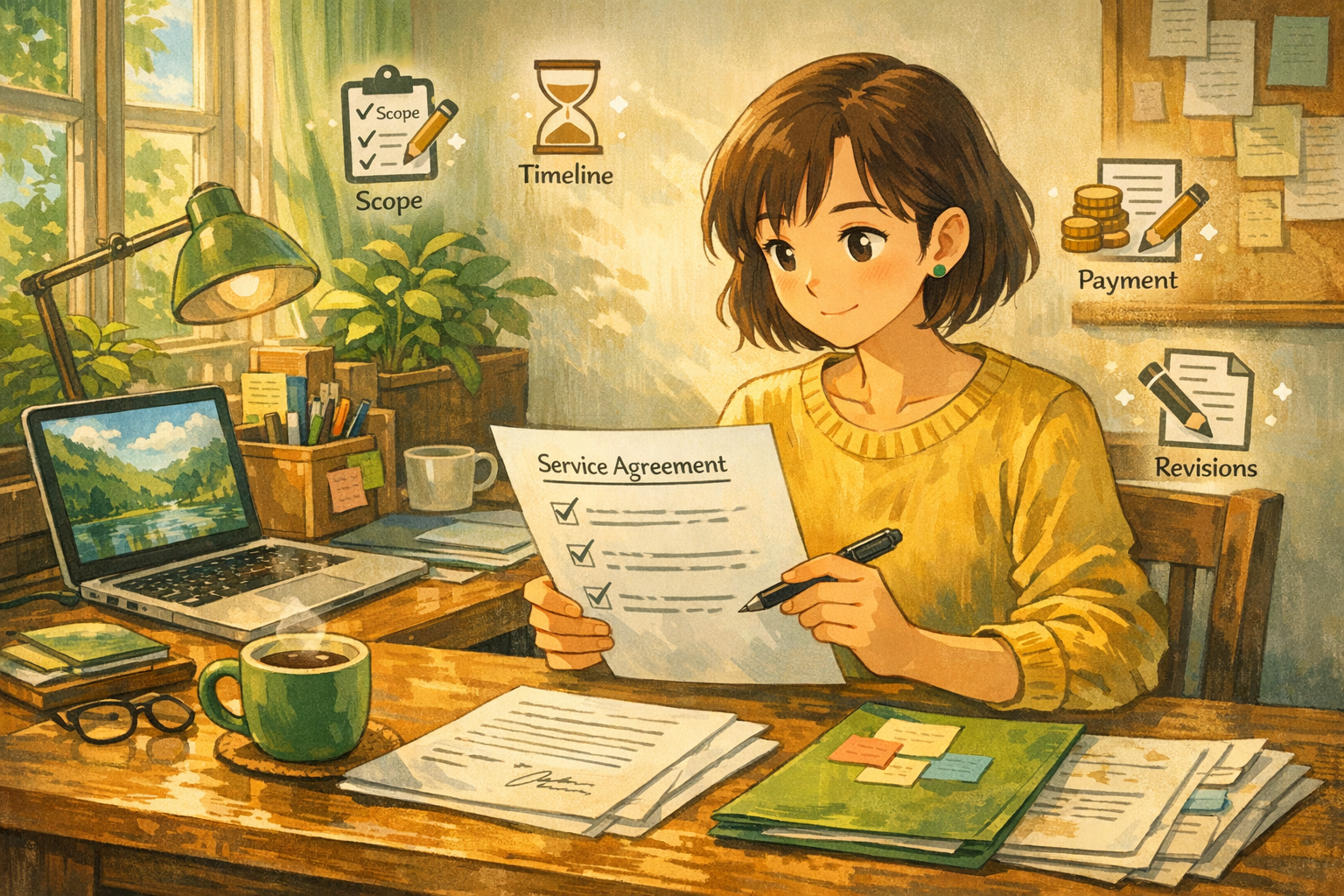
If you freelance long enough, you will eventually learn that a great project can still go sideways if the agreement is vague. Scope expands. Timelines blur. Payment gets delayed. Revisions multiply. And suddenly, what felt like a straightforward engagement turns into a stressful back-and-forth about what was actually promised.
A freelance service agreement helps prevent that. It gives both you and your client a shared understanding of the work, the process, the payment terms, and what happens if things change. But here is the challenge: writing a new contract from scratch for every project is time-consuming, inconsistent, and easy to get wrong.
The better approach is to create one simple, reusable agreement that you can adapt to different clients and services. Think of it as a strong baseline document: clear enough to protect your business, flexible enough to fit different projects, and simple enough that clients can review and sign it without friction.
In this guide, you will learn how to build that kind of agreement, what clauses to include, how to keep it practical, and how to turn it into a repeatable part of your client onboarding process. If you regularly sell services, this is exactly the kind of operational system Schemon is designed to support: standardizing your service delivery, documenting repeatable steps, and making sure every client engagement starts on the right footing.
Why every freelancer needs a reusable agreement
A service agreement is not just a legal formality. It is a communication tool. The best agreements reduce ambiguity and make expectations obvious before work begins.
When your agreement is reusable, you gain more than efficiency:
- You save time by editing a proven template instead of drafting from zero
- You reduce mistakes because core terms stay consistent across projects
- You look more professional when clients receive a polished, standardized document
- You make onboarding smoother because your process becomes predictable
- You create a stronger business foundation that is easier to scale over time
Many freelancers delay creating a reusable agreement because they assume it needs to be long, complicated, or filled with legal jargon. In reality, the most effective freelance agreements are often the clearest and simplest. They cover the essentials in plain language and leave little room for confusion.
If your service business is growing, this is where systems matter. Schemon is especially useful when you want to turn one-off client admin into a repeatable workflow. A reusable agreement should not live in isolation. It should connect to how you scope work, collect client details, confirm deliverables, and move projects forward consistently.
Start with the core purpose of the agreement
Before you write clauses, define what your agreement needs to accomplish. A good freelance service agreement should do three things:
- Describe what you are doing
- Explain how the relationship will work
- Protect both parties if expectations change or problems arise
That sounds simple, but many agreements fail because they overemphasize one of these and ignore the others. For example, some are too focused on legal protection and barely explain the practical workflow. Others describe the service but say nothing about payment timing, revision limits, or ownership of final work.
To keep your agreement reusable, build it in layers:
- A standard foundation that stays mostly the same for every client
- A variable project section where you customize scope, pricing, timing, and deliverables
This structure is useful because your legal and operational terms do not need to be reinvented each time. Only the project-specific details need to change. That is what makes the agreement reusable.
A practical way to think about it is this: your agreement should answer the questions a reasonable client would ask before saying yes. What am I getting? When will I get it? What do I need to provide? How much will it cost? What happens if I need changes? What happens if we stop working together?
If you already use service templates, intake forms, or standardized delivery steps, your agreement should reflect that same logic. Schemon can help centralize those repeatable service elements so your contract terms align with your actual process instead of being a disconnected document you only revisit when something goes wrong.
The essential clauses to include in a simple freelance agreement
You do not need a 20-page contract to create a strong freelance agreement. In most cases, a concise document with the right clauses is more effective than a long one nobody fully reads. Here are the core sections to include.
1. Parties and effective date
State who is entering the agreement and when it becomes effective. Use full legal names and business names if applicable.
2. Services and scope of work
This is the heart of the agreement. Describe the service clearly and specifically. Avoid vague phrases like “design support” or “marketing help” unless they are followed by concrete deliverables.
Include details such as:
- What you will deliver
- What is included in the service
- What is not included in the service
- Any assumptions or dependencies
The more clearly you define scope, the easier it is to manage expectations. If your work tends to vary by client, reference an attached proposal, statement of work, or project summary.
3. Timeline and milestones
State when the project starts, expected delivery dates, and any milestone schedule. If timelines depend on client feedback or assets, say so explicitly.
For example, you might note that deadlines move if the client delays approvals, content, or requested information. This protects you from being held responsible for bottlenecks outside your control.
4. Fees and payment terms
Be precise. Include your pricing structure, deposit requirements, invoice schedule, accepted payment methods, and when payment is due.
Common options include:
- Fixed project fee
- Monthly retainer
- Hourly billing with an estimated range
- Milestone-based payments
Also include late payment terms if relevant. Even a simple sentence about overdue invoices can make a big difference.
5. Revisions and change requests
This clause saves freelancers from endless unpaid work. Define how many revisions are included and what qualifies as a revision versus a new request.
For example:
- Two rounds of revisions are included in the quoted fee
- Additional revisions are billed at a specified rate
- Changes outside the agreed scope require a separate estimate or addendum
This is one of the most important sections in service businesses because it directly affects profitability.
6. Client responsibilities
Your client usually has obligations too. They may need to provide content, approvals, access, feedback, or decision-makers. Put that in writing.
When client responsibilities are clear, it becomes much easier to handle delays and keep projects moving.
7. Intellectual property and usage rights
Clarify who owns what and when ownership transfers. In many freelance arrangements, final deliverables transfer to the client only after full payment is received. If you retain rights to drafts, source files, methods, or portfolio use, say so.
This section should reflect the type of service you offer. A writer, designer, developer, consultant, and strategist may all need different language here.
8. Confidentiality
If you may access sensitive business information, include a confidentiality clause. It reassures clients and sets boundaries for both parties.
9. Termination
Explain how either party can end the agreement and what happens financially if that occurs. For example, you may state that work completed up to the termination date is billable and any deposit is non-refundable.
10. Limitation of liability and legal basics
Depending on your jurisdiction and risk level, you may want a basic limitation of liability clause, a governing law clause, and language confirming the freelancer is an independent contractor. If possible, have a legal professional review your template once so you can reuse it confidently.
The point is not to make your agreement intimidating. It is to make it complete enough that both practical and legal expectations are covered.
How to write it in plain language clients will actually understand
A reusable agreement should be easy for clients to review. If they need a translator to understand it, signing gets delayed and trust can decrease. Plain language does not make your agreement weaker. In many cases, it makes it stronger because there is less room for misunderstanding.
Here are a few ways to keep it clear:
- Use short sections with descriptive headings
- Prefer direct wording over legal jargon where possible
- Define important terms if you use them repeatedly
- Keep sentences specific and concrete
- Avoid ambiguous words like “reasonable” unless context is clear
For example, instead of writing “Contractor shall provide services as mutually agreed,” write “Freelancer will deliver the website copy described in Exhibit A.” It is more precise and easier to enforce in practice.
Another helpful tactic is to separate reusable legal terms from project-specific details. Your standard terms can stay stable, while your scope and pricing can be inserted into a project summary or order form. This makes updates faster and lowers the chance of editing the wrong clause.
If your service process includes repeated steps such as discovery, client questionnaires, approvals, and handoff, document those steps consistently across your agreement and onboarding materials. Schemon is valuable here because it helps service businesses turn scattered process knowledge into structured, repeatable systems. That means your agreement can match the real way you work, not an idealized version you forget to follow once the project starts.
Turn your agreement into a reusable template system
Once you have a strong draft, the next step is to make it truly reusable. That means designing it so you can duplicate it, customize it quickly, and send it without second-guessing the content every time.
Here is a practical template system you can use:
- Master agreement template with standard legal and process terms
- Project summary section with variables like client name, deliverables, fee, timeline, and revision count
- Optional add-ons or service-specific clauses for different types of work
- A checklist for what must be customized before sending
Your checklist might include:
- Confirm client legal name and address
- Confirm project title and description
- Insert pricing and payment schedule
- Insert timeline and milestone dates
- Confirm revision terms and exclusions
- Add any service-specific notes or files
This is where many freelancers can save serious time. Instead of opening an old contract and editing random sections, you create a reliable system. The more standardized your service delivery becomes, the easier it is to support with templates, workflows, and documentation.
Schemon is especially relevant if you want to go beyond a single agreement and build a repeatable client onboarding operation. For example, your agreement can be one part of a larger service workflow that includes intake, internal prep, client communication, and fulfillment steps. When those elements are documented and organized, you spend less time reinventing your process and more time delivering value.
Common mistakes freelancers make with service agreements
Even when freelancers use contracts, there are a few recurring mistakes that create avoidable risk.
Being too vague about scope
If the agreement does not clearly define what is included, clients may assume more than you intended. This is one of the biggest causes of scope creep.
Leaving out client responsibilities
Projects often depend on timely feedback, content, access, or approvals. If that is not documented, delays become harder to manage.
Not defining revisions
Unlimited revisions can quietly destroy margins. Always specify what is included.
Using a template you do not understand
Copying a contract from the internet without understanding it can create false confidence. Your agreement should reflect your actual services and business model.
Failing to update the template over time
Your agreement should evolve with your business. If you keep seeing the same friction point in projects, update the template to address it.
Keeping the contract separate from your process
An agreement works best when it is part of a larger operating system. If your onboarding, delivery, and communication are inconsistent, even a good contract will not solve every issue. This is another reason tools like Schemon matter. They help you operationalize your service process so your agreements, workflows, and delivery standards reinforce each other.
When to get legal review and how to keep improving your template
A simple freelance agreement can take you far, but there are situations where legal review is worth the investment:
- You work on high-value projects
- You handle sensitive data or regulated industries
- You license intellectual property or retain complex usage rights
- You work across jurisdictions or with enterprise clients
- You want stronger protection around liability, indemnity, or termination terms
Even if you start with a practical draft on your own, having a lawyer review your template once can give you a reusable foundation you trust. That is often far more affordable than dealing with a dispute later.
After that, treat your agreement like a living business asset. Review it regularly. Note where clients ask repeated questions. Watch where projects tend to drift. Every issue that repeats is a signal that your process or wording may need improvement.
You can also create versions for different service types. For example:
- A project-based agreement for fixed-scope work
- A retainer agreement for ongoing monthly support
- A consulting agreement for advisory sessions and strategy work
As your service business matures, these templates become part of your operating playbook. That is exactly the type of structure Schemon helps businesses build: repeatable systems that make delivery more consistent, scalable, and less dependent on memory or improvisation.
Conclusion
A simple, reusable freelance service agreement is one of the highest-leverage documents in your business. It protects your time, clarifies your value, reduces misunderstandings, and turns client onboarding into a more professional experience.
You do not need to create the perfect contract on day one. Start with a clear structure, include the essential clauses, write in plain language, and customize only the project-specific details. Then improve it over time as your services evolve.
Most importantly, do not treat the agreement as a standalone file. It works best when it is part of a repeatable service system that includes scoping, onboarding, approvals, and delivery. If you want to make your freelance process more organized and reusable from end to end, Schemon can help you document and standardize the way your service business runs.
Ready to turn your freelance agreement into a smoother, more scalable client workflow? Visit https://app.schemon.com to try Schemon and build a more consistent service process around every client engagement.


Subscribe to our email newsletter today!