What to Track in Your Business (and What to Ignore)
Tracking the correct metrics is important for your business

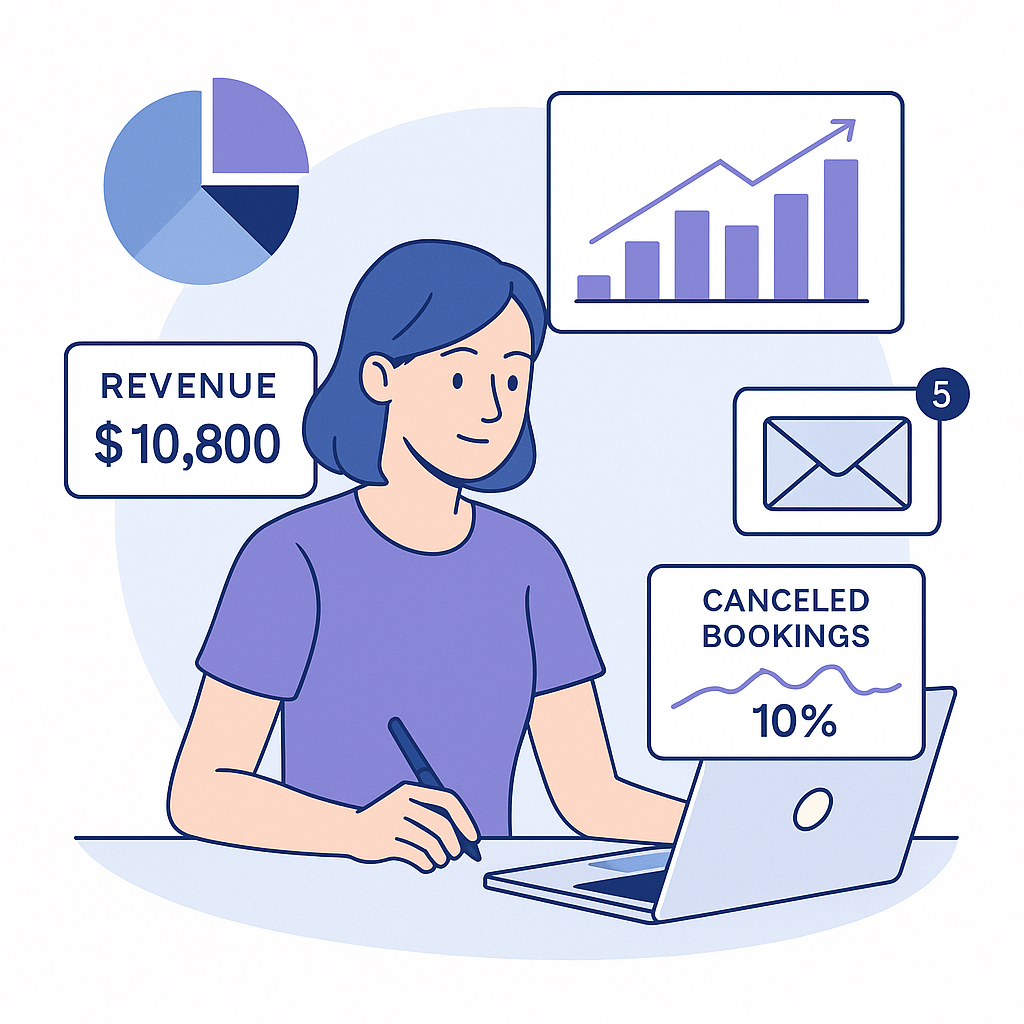


If you’re a freelancer or small business owner, you’ve probably felt both of these:
- The anxiety of not tracking anything (“Am I even growing?”), and
- The overwhelm of tracking everything (“Why do I have 12 dashboards and no idea what to do next?”).
Modern tools make it easy to collect data. The hard part is knowing what actually matters.
This guide will walk you through:
- What to track in your business so you can make better decisions
- Which “vanity metrics” you can safely ignore
- How to build a small, powerful set of KPIs instead of a noisy dashboard
- How to use booking and scheduling data to understand your service business
By the end, you’ll know exactly which numbers deserve your attention—and which ones you can stop feeling guilty about.
The Real Purpose of Tracking: Decisions, Not Dashboards
Before listing metrics, it’s important to get one thing straight: You don’t track numbers to “have reports.” You track numbers to make decisions.
A metric is useful when it helps you answer questions like:
- “Should I keep offering this service?”
- “Should I spend more on ads or stop them?”
- “Do I need to raise my prices?”
- “Can I afford to hire help?”
If a metric doesn’t drive decisions, it’s just noise. So instead of trying to track every possible data point, focus on a small number of high-impact metrics that reveal:
- Is money flowing in?
- Are the right clients coming in?
- Is your time being used wisely?
- Are clients happy enough to come back and refer others?
Let’s break that down.
Money: The Essential Business Metrics to Track
You don’t need to be an accountant, but you do need to understand the basic story of your money.
1. Monthly Revenue
What it is: Total sales for the month (from all services, packages, or products).
Why it matters: It shows whether your business is growing, shrinking, or staying flat.
How to use it:
- Compare month over month to see trends
- Track seasonality (which months are consistently strong or weak)
- Set realistic revenue goals
2. Profit (Not Just Revenue)
What it is: Revenue minus expenses.
Why it matters: High revenue means nothing if your costs are eating it all. Profit tells you what you actually get to keep.
How to use it:
- Watch profit margin percentage (profit ÷ revenue)
- Identify expenses you can cut without hurting quality
- Decide when it’s safe to invest in tools, training, or help
3. Cash Flow
What it is: The timing of money coming in and going out.
Why it matters: You might be “profitable on paper” but still struggle to pay bills if clients pay late or you only invoice at the end of a project.
How to use it:
- Track when invoices are sent and paid
- Use upfront deposits or prepayment for bookings
- Smooth out your income with recurring services or retainers
4. Revenue by Service or Offer
What it is: How much each service, package, or product brings in.
Why it matters: Not every offer contributes equally. Some might be popular but low-margin, others rare but highly profitable.
How to use it:
- Identify which services deserve more promotion
- Spot offers that aren’t worth your time
- Decide what to simplify, bundle, or retire
If you run a service business with online booking, this is where a tool that records bookings per service becomes extremely valuable.
Clients and Marketing: Know What Actually Brings You Business
Marketing feels mysterious until you track what actually works.
5. Number of Leads or Inquiries
What it is: People who reach out with some level of interest—booking links clicked, forms submitted, DMs about working with you, discovery calls scheduled.
Why it matters: If revenue is low, you need to know if it’s because:
- Not enough people are finding you, or
- Enough people do find you but don’t convert
How to use it:
- Track leads per channel (Instagram, LinkedIn, referrals, SEO, ads)
- Double down on channels that consistently send leads
- Rework or drop channels that don’t produce results
6. Conversion Rate (Lead → Client)
What it is: The percentage of leads that turn into paying clients. Example: If 20 people book a discovery call and 5 become clients, your conversion rate is 25%.
Why it matters: A low conversion rate suggests issues with:
- Positioning or pricing
- How you explain your services
- Your sales process or client fit
How to use it:
- Improve your offers and sales conversations
- Adjust your website, booking forms, and FAQs to answer common objections
- Consider offering a simpler “starter” service to lower the barrier
7. Client Retention and Repeat Bookings
What it is: How many clients come back again (and how often).
Why it matters: It’s almost always cheaper to keep a client than to find a new one. Retention is a direct indicator of value and satisfaction.
How to use it:
- Track how many clients book multiple sessions or projects
- Design follow-up services, maintenance packages, or check-ins
- Use gentle reminders to re-engage past clients
If you use an online scheduling system, this metric becomes easy: you can see how many times each client booked and which services they prefer.
Time & Operations: Is Your Schedule Working for You or Against You?
You’re not just tracking money; you’re tracking how your time turns into money.
8. Utilisation: How Much of Your Time is Booked
What it is: The percentage of your available working hours that are filled with billable work.
Why it matters: It reveals two extremes:
- Underbooked → You need more marketing, better offers, or different pricing
- Overbooked → You may be undercharging, overcommitting, or at risk of burnout
How to use it:
- Set a realistic target (e.g. 60–80% utilisation)
- Adjust your availability and prices accordingly
- Consider waitlists or hiring help when consistently overbooked
9. No-Show and Cancellation Rate
What it is: How often people miss bookings or cancel last minute.
Why it matters: No-shows waste your time and cost you real money.
How to use it:
- If the rate is high, introduce upfront deposits, stronger reminders, or clearer policies
- Offer easy rescheduling with boundaries (e.g. “24 hours’ notice”)
- Adjust your confirmation & reminder messages to set expectations
10. Average Project or Session Duration
What it is: How long your projects or sessions actually take versus what you expect.
Why it matters: Scope creep, unclear expectations, or underestimation will eat your schedule alive.
How to use it:
- Compare planned time vs. actual time
- Update your package descriptions and prices
- Create tighter boundaries around what’s included
Customer Experience: Are People Happy Enough to Stay and Refer?
Happy clients don’t just come back—they bring others.
11. Client Satisfaction (Reviews, Ratings, or Simple Surveys)
You don’t need complex systems. A few simple signals go a long way:
- Star ratings on Google, platforms, or your own site
- Short surveys after a project (“What was most valuable?”, “Anything we could improve?”)
- Whether people are willing to provide testimonials
How to use it:
- Highlight positive feedback as social proof
- Fix recurring issues that show up in reviews
- Use language from happy clients in your marketing
12. Referrals
What it is: How many new clients come from existing clients.
Why it matters: High referral volume means:
- Your service is working
- Trust is strong
- It’s time to make referrals deliberate (thank-yous, referral programs, etc.)
Even a simple “How did you hear about me?” question on your booking form helps you track this.
What to Ignore: Vanity Metrics and Data That Doesn’t Change Your Behaviour
Now, the fun part: what you can stop obsessing about.
1. Social Media Vanity Metrics (On Their Own)
- Follower count
- Likes
- Impressions
These are only useful if they correlate with leads and bookings. 10,000 followers who never buy are less valuable than 100 followers who book regularly.
Better approach: track:
- Link clicks to your booking page
- Actual inquiries or calls coming from each platform
2. Hyper-Granular Data You’ll Never Act On
If you’re not a big team with a dedicated analyst, you don’t need:
- 30 different segmentation dashboards
- Minute-by-minute traffic charts
- Complex attribution models
If you never use a metric to take action, stop tracking it or hide it from your main dashboard.
3. Metrics You Can’t Measure Reliably
Some numbers are nice in theory but difficult to measure accurately without heavy setup. If you find yourself guessing or manually filling in spreadsheets you hate, it might be better to:
- Simplify what you track
- Use tools that auto-capture the basics (bookings, revenue, cancellations)
- Focus on fewer, solid numbers rather than many fuzzy ones
How to Choose Your “Critical Five” Business Metrics
To avoid overwhelm, choose five core metrics you look at weekly or monthly. A simple, powerful set for most service businesses looks like this:
- Monthly revenue
- Profit
- Number of bookings (or projects started)
- Conversion rate (inquiries → clients)
- No-show/cancellation rate
You can always add more, but start with a focused group that answers:
- Are we making money?
- Are enough people booking?
- Is the process reliable?
Turn Numbers into Rituals, Not Random Panic
Metrics matter most when you build a simple review habit.
Try this monthly ritual:
- Review your numbers
- Revenue, profit, bookings, leads, cancellations
- Ask: What’s working?
- Which channels or offers performed best?
- Ask: What’s not working?
- Any metrics getting worse? Why?
- Decide on 1–3 actions
- Raise prices for an overbooked service
- Improve reminders to reduce no-shows
- Put more effort into the channel bringing the best clients
You don’t need a three-hour strategy session. A focused 30–60 minutes can completely change your direction over time.
How Schemon Helps You Track the Right Things Automatically
If you provide services—coaching, consulting, freelancing, beauty, wellness, local services—many of your most important metrics come from how people book you. That’s where Schemon comes in.
Schemon helps you:
- Create professional booking pages for each service
- Let clients choose times from your real availability
- Accept online payments or deposits
- Reduce no-shows with automatic reminders
- Keep client details, bookings, and communication in one place
Most importantly for tracking, Schemon gives you clear visibility on:
- How many bookings you get and for which services
- When your busy and quiet periods are
- Which services generate the most revenue
- Which clients are returning vs. new
- Your cancellation and no-show rates
Instead of stitching together spreadsheets, screenshots, and half-remembered notes, you get a single source of truth for the metrics that actually matter.
Ready to Focus on the Numbers That Move Your Business Forward?
You don’t need more data. You need the right data, looked at regularly, turned into clear decisions.
Track:
- Money that matters
- Clients and bookings
- Time and utilisation
- Customer happiness
Ignore:
- Metrics that don’t drive decisions
- Vanity numbers that only look good in screenshots
And use tools that capture key metrics automatically instead of adding more admin to your plate.
👉 Want your bookings, revenue, and client data in one place?
Set up your services and start tracking what really matters with Schemon today.


Subscribe to our email newsletter today!